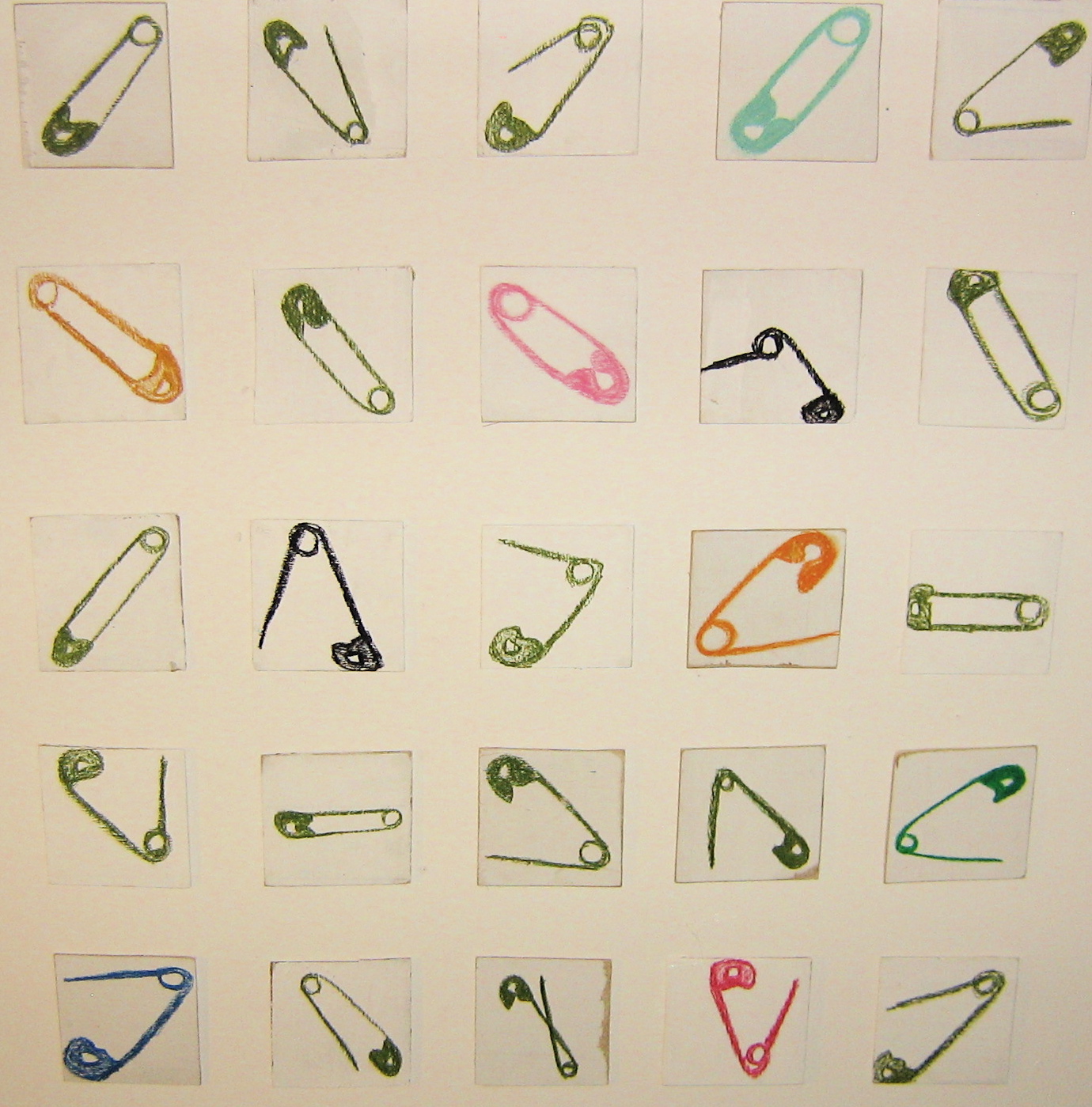
A Visual History of the Safety Pin
Antiquity
In Homer’s Odyssey, Antinous, (one of the unscrupulous suitors of Odysseus’ wife Penelope) presents Penelope with a gift of jeweled pins in an attempt to seduce her:
Then Antinous said, “Queen Penelope, daughter of Icarius, take as many presents as you please from any one who will give them to you; it is not well to refuse a present; but we will not go about our business nor stir from where we are, till you have married the best man among us whoever he may be.”
The others applauded what Antinous had said, and each one sent his servant to bring his present. Antinous’s man returned with a large and lovely dress most exquisitely embroidered. It had twelve beautifully made pins of pure gold with which to fasten it and gleamed like sunlight…
Herodotus’s Histories mention the long, dagger-like pins Athenian women used to fasten their tunics, and recount the murder of an Athenian soldier by a group of angry women who stabbed him to death with their cloak pins. A law was passed forbidding the wearing of the Athenian-style tunic.

Ancient Roman Fibula
The Latin Fibula is an ancient precursor to the safety pin, used in the ancient and early medieval world to keep togas, cloaks, hoods, and other kinds of clothing fastened in place, replacing the straight pins used in the Neolithic period and the Bronze Age. Most fibulae are made of bronze or iron, but some were encrusted with jewels, decorated with enamel, glass, coral or bone.
Anatomy of the Fibula
The four parts of a Fibula are the Body, the Pin, the Spring, and the Hinge.

The Body
The Body of the Fibula was generally one of two types, either long and narrow, referred to as a “Bow,” or flat and wide, called a “Plate.” Bow type Fibulae appeared in the late Bronze Age, using simple forms, at first a low flat arch, and later, by the 6th Century BC, a more rounded, higher arch. Decorative variations developed, using spirals, oval, and diamond shaped forms. In the Roman Era in the 1st Century AD, a wide variety of variations in the fibula Body proliferated, including shapes of common weapons, animal shapes, and other highly decorative embellishments. The spring or hinge end of the Body is referred to as the Head and the end where the fibula closes is called the Foot. Fibulae were worn facing up, down, or to the side, depending on the culture and time period.

The Pin
The pin of a Fibula was either a continuation of the body, or a separate piece that attached to it. The Catch Plate is the name of the connection point which closed the fibula, holding the Pin in place.
The Spring
Early Fibulae had a unilateral Spring, which provided tension to the Pin. Unilateral Springs wound in one direction only, replaced later by bilateral springs, which wrapped around a holding pin or axel. By the 1st Century AD some springs were concealed under a metal cover that was an extension of the fibula Body.
The Hinge
The early 1st Century AD saw the development of the Hinge, which attached the Pin to the Plate of the Body. In the 3rd Century AD the famous Crossbow Fibula design was created by placing the Hinge in the center of a long transverse bar. Spring-type and Hinge-type fibulae were used contemporaneously
Medieval Europe
Wealthy people of rank used elaborate safety pins of silver, gold, brass, and ivory. The poor most likely used wooden skewers. By the fifteenth century, pins were made from drawn iron wire.
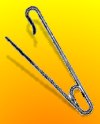
Walter Hunt & The Invention of the Modern Safety Pin

Walter Hunt (1796-1859) was a mechanic living in New York state, a prolific inventor, a man whose ethics and humility prevented him from profiting greatly from his inventions.
In 1846, Hunt invented the lockstitch sewing machine, and suggested to his daughter that she manufacture the device. When she pointed out to him that this machine would put many poor women in the garment industry out of work, hunt dropped the idea and never patented his invention.
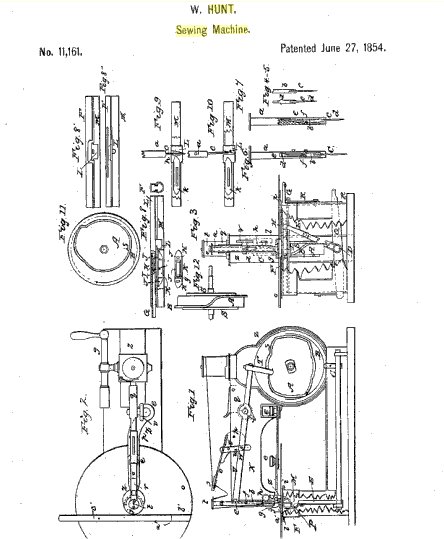
In 1849, Hunt was struggling financially. Reportedly, he sat in his workshop, worrying about how to pay off a $15 debt he owed to a friend, while playing with a length of wire. As he was twisting it, he discovered that when coiled and then clasped to itself, the wire retained enough spring to be unclasped and clasped again. He completed a prototype and several design sketches in one evening, patented the device on April 10th, 1849, and subsequently sold the patent for $400 to W.R. Grace and Company to pay off the debt to his friend.

The design of the safety pin has remained virtually the same ever since. In addition to the safety pin and lockstitch sewing machine, Hunt also invented the a forerunner of the Winchester repeating rifle, a successful flax spinner, a knife sharpener, a fountain pen, a rope-making machine, a streetcar bell, hard-coal-burning stove, artificial stone, street sweeping machinery, the velocipede, and the ice plough. He sold the patents to most of his inventions for minimal sums, lived modestly, and received little recognition for his many inventions after his death.


Mass Production
For centuries, metal pins remained expensive and costly items. The term “pin money,” originally referred to the custom of a head of household presenting the lady of the house with a sum of money on the first or second day of January, which she would use to purchase her pins for the year. However, the mechanization of production in the 1800’s changed the cost and status of the safety pin. In 1838, Samuel Slocum founded a pin factory in Poughkeepsie, NY, capable of producing 100,000 pins a day. Most safety pins today are made from steel, brass, and stainless steel. Today, over 3 million safety pins can be made by one factory in a single day.
Punk Rock and Fashion
In the nineteen seventies, punk rock emerged with its own particular aesthetic, which some attribute to Richard Hell, songwriter, singer, bass guitarist and writer (Neon Boys, Television, the Heartbreakers, and Richard Hell & the Voidoids.) Some rock historians contend that the adoption of the safety pin as part of the punk look came from Hell’s early accessorizing. Others, notably Johnny Rotten of the Sex Pistols, dispute this claim, insisting that safety pins were originally incorporated for more practical reasons, for example, to remedy “the arse of your pants falling out”. Safety pins came to be used for body piercings and clothing decoration, and grew to be a symbol of punk culture among media and pop culture outlets. The “stick and poke” tattoo is a popular form of DIY (Do It Yourself) tattooing that utilizes a safety pin and ink.

The Safety Pin in Sports
Given the huge amount of money spent on sports wear and team outfits, why has no one come up with a better solution for attaching the competitor’s numbers to their vests other than using safety pins?
Well, it’s a matter of logistical convenience, says Andy Dixon, editor of Runner’s World. All the bibs [in the Olympics this year] are produced and controlled by Locog in London, and athletes are only given their bibs in the first call-room, about 40 minutes before the start of their event, where all of their kit gets checked to make sure it complies with Olympic rules (for example, it doesn’t feature any unauthorized logos). Their uniform will have been manufactured months in advance.
“Safety pins still trump self-adhesive labels, as the latter still depend upon how dry the material is when applied, and can sometimes come unstuck during rain or when the athlete gets sweaty,” says Dixon. “For all their low-tech utilitarian nature, safety pins are clearly a successful product design – they have been around since before the first modern Olympics were even a glint in Baron de Coubertin’s eye.”
The Safety Pin Today
Although more modern fasteners like velcro have been introduced in the 20th century, the safety pin remains an everyday necessity throughout the world.
Its simplicity, elegance and household presence made it not only an item of utility, but also of culture and tradition. In some places in India, for example, safety pins and sewing needles are kept for generations and passed from mother to daughter. In the Ukraine it is still a practice today to pin safety pins to the inside of a child’s clothing, to ward off evil spirits. In many European countries, finding a safety pin is good luck, and a portent of good fortune.